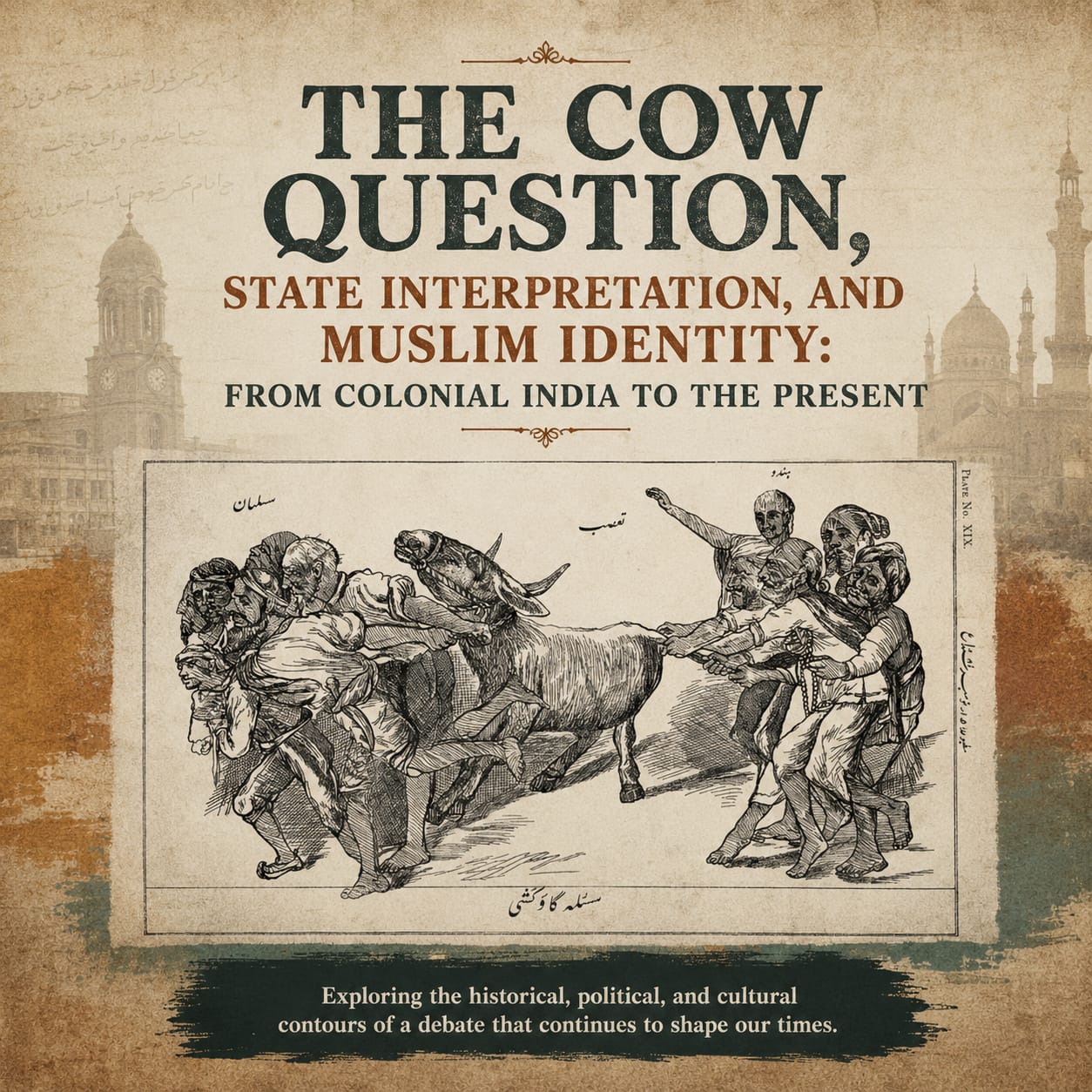
The alarming rise in mob lynching incidents across India, perpetrated under the banner of cow protection, has emerged as one of the most disturbing fault lines in the country's contemporary communal landscape. According to a 2019 Human Rights Watch report, between 2015 and 2018 over one hundred cow vigilante attacks left 36 Muslims dead and 280 wounded. The recent episode in West Bengal, alongside calls from certain Muslim leadership figures for the cow to be formally designated as the national animal, has thrust this fraught debate back into public discourse. Maulana Arshad Madni, President of Jamiat Ulema e Hind, has demanded that the cow be declared the national animal of India to permanently end hate politics and mob lynching. Madani's rationale rests on the premise that, given the majority community's veneration of the cow as a sacred and maternal figure, granting it national symbolic status would offer a durable legal and social remedy to recurring communal strife. Yet the so-called Cow Question is neither a product of modernity nor a matter reducible to the animal itself — its genealogy extends deep into the subcontinent's tangled religious and political heritage.
The medieval legend of Salar Ghazi, a celebrated warrior-saint of North India, furnishes one of the earliest illustrations of this entanglement between Islamic identity and the symbol of the cow. Although established narratives recognize him as a founding Muslim conqueror, the bardic tradition simultaneously clothed him in the attributes of a local Indic deity — a divine being who had assumed earthly form. In this popular version, the Muslim saint fights on the side of good and dies the death of an Indic epic warrior: in battle as a virgin on his wedding day. Salar Ghazi embraces martyrdom, according to the oral tales, when he goes to fight a tyrannical Hindu raja who had attacked his devotees, the local (non-Muslim and low-status) herdsmen and their cows. In other words, he fights both as a Muslim saint spreading his faith and as an epic Indic god-hero responding to the dharmic call of "save the kine" (gao guhar), and, thus, he lays down his life simultaneously for Islam and cows. [1]
Under Colonial Rule:
To apprehend the pre-Partition contours of this question, historian Rohit De offers a precise analytical account:
"The nineteenth century saw a transformation in both the nature of the conflict and the way it was managed with the intrusion of the colonial state. . . . The reformulation of the cow question divided Hindus from Muslims (communities that had had a long experience with each other), upper-caste Hindus from the lower castes, and Hindus from Britons (communities that were relative strangers). The colonial state came to be associated with beef consumption, and the British army became the largest buyer of beef. The colonial state had long been resistant to the idea of banning cow slaughter." [2]
The communal and political charge surrounding the cow reached a new pitch in 1881, when the Arya Samaj, under the leadership of Dayananda Saraswati, established the hugely influential Cow Protection Society (Gorakshni Sabha) that sought to halt the slaughter of cattle in India and was especially active in Panjab and Northern India. From that point forward, "the cow emerged as a powerful anticolonial symbol and became the focus of both mobilization and violence through much of north India." [3] The scale of ensuing violence was staggering. As De informs us, "In 1893 alone, a hundred people were killed in communal violence over cow slaughter in towns as far apart as Junagarh, Oudh, and Rangoon." [4]
Through the closing decades of the nineteenth century and into the early twentieth, as the Khilafat movement advanced with considerable force, the matter of cow slaughter transformed into a site of intense jurisprudential and intellectual dispute among South Asian Muslim scholars, generating voluminous and impassioned deliberation. While opinions on this matter varied considerably, for heuristic purposes, we can posit two broad tendencies found among the Muslim scholarly elite. One current, represented by scholars aligned with the Khilafat movement, called upon Indian Muslims to desist from cow slaughter and sacrifice in order to avoid provoking the religious sensibilities of the Hindu community. Their advocacy for substituting the cow with other animals — such as goats and sheep — for sacrificial purposes was a deliberate component of a wider effort to cultivate Hindu-Muslim solidarity, itself indispensable to their political alliance with Gandhi and the Indian National Congress. By forging a political alliance with Gandhi through the promotion of Hindu-Muslim friendship, leaders of the Khilafat movement had sought to pressure the British colonial state into preserving the territorial integrity of the Ottoman Caliphate. Crucially, their argument regarding abstention from cow sacrifice was based not on some abstract appeal to liberal pluralism, but on a specific reading of the Islamic legal tradition, premised on the observation that cow sacrifice is not an obligatory (wajib) but only a permissible (mubah) practice in Islamic law. Hence, refraining from it posed no normative pitfalls. One can name scholars like Qiyamudin 'Abdul Bari (d. 1926) of the Farangi Mahal school, who is one of the major protagonists of this chapter, and, again, 'Abu'l Kalam Azad, as prominent examples of scholars who held this position.
A rival bloc of Muslim scholars mounted a determined counter-argument. Their position held that cow sacrifice operated as an irreplaceable emblem of Muslim distinctiveness within the Indian context, and that its abandonment would constitute a profound degradation of Muslim dignity. While cow sacrifice and the consumption of beef were generally not obligatory, abandoning a distinctive symbol of Islam for the sake of appeasing and under the pressure and coercion of Hindus, they argued, was certainly forbidden. It followed, therefore, that for Indian Muslims in their specific historical predicament, cow sacrifice effectively assumed the character of a binding obligation. Ahmad Raza Khan even wrote a text in 1880 titled "Anfus al Fikr fi Qurban al Bakr" (The Finest Viewpoint on Cow Sacrifice). At the heart of Khan's argument was the claim that since cow sacrifice was a public marker of Muslim distinction, it signified Islam's honor and dominance in the public sphere. In the absence of Muslim political sovereignty, it was in ritual life and performance that power was enshrined. To relinquish such a ritual under pressure from a non-Muslim community was, in his reckoning, tantamount to a public confession of Islam's subjugation. And Khan poignantly put it, "Our Sharia' can never desire our humiliation." In one place, Khan thundered, "Those who seek to befriend the enemies of Islam are themselves Islam's enemies. Such people are not scholars; they are tyrants. They will spend their afterlife alongside the Hindu Idolaters." [5] Khan also warned against the effects of the precedent that forbidding cow sacrifice would set into motion. So, he anxiously prognosticated, under the pretext of guarding religious sensitivity and preventing public disorder, Hindus would be able to declare any number of animals sacred and have their killing banned. "Soon," he mockingly remarked, "we would be forbidden even from killing venomous animals like snakes that pose a grave threat to humans because they are considered godly by some Hindus." [6]
On the opposing side, Maulana Azad and Abdul Bari of Farangi Mahal sought to harness the cow question as a bridge toward Hindu-Muslim reconciliation. Yet Abdul Bari was meticulous in delineating the limits of his own stance, adamantly pronouncing: "I am not giving a fatwa or even a recommendation pushing people to abandon cow slaughter; I am just offering my preliminary opinion with a view to foster [Hindu-Muslim] unity." [7] He was equally determined to rebuff any suggestion that his position had been shaped by external political compulsion, directly addressing the charges laid by adversaries such as Ahmad Raza Khan. He reinforced this point with characteristic firmness: "Had Gandhi asked me to give up cow sacrifice, I would have absolutely never done so." [8] His rhetorical strategy involved reclaiming, on his own terms, the very category of "distinguishing markers of Islam" (sha'air-i Islam) that opponents had wielded against the case for restraint. He reasoned that the Hindu-Muslim solidarity achievable through Muslim forbearance on cow sacrifice was a politically necessary condition for resisting British colonialism and, by extension, for safeguarding the Ottoman Caliphate — an institution he regarded as immeasurably more central to Muslim identity than the singular act of cow sacrifice. As he bluntly asked: "What is the cow when put next to the caliphate?" Notwithstanding this, he stopped well short of calling for the wholesale renunciation of the ritual. In his own formulation:
Cow sacrifice is not obligatory (wajib) but simply permissible (mubah); there are many other animals whose sacrifice is preferable to that of the cow. A person [Muslim] has the prerogative to abandon cow sacrifice and beef consumption on grounds that they are not obligatory but simply permissible. One should not insist on sacrificing just for the sake of instigating chaos and unrest. Yes, if the Hindus try to forcibly get Indian Muslims to abandon cow sacrifice, in that case the latter must fully strive to establish this ritual. This religious marker of distinction must not be abandoned due to the coercion [of another community] (jabar se yeh shi'ar-i mazhabi tark nahin karna chahiyay; emphasis mine).
A Case Study: Bihar
According to Sharjeel Imam, after years of resurgence of the cow protection movement, the Baqrid of 1917 led to a massive show of strength by the Hindus. "Many thousand Hindus streamed into the village of Piru from places all over the district." In the massive riots that followed, more than 150 villages were looted and at least 41 killed in Bihar. [9]
Women and the cow constituted the twin symbols most extensively weaponized in anti-Muslim propaganda throughout late-colonial Bihar. That said, targeted violence against Muslims on the pretext of cow protection predates even this period, with documented attacks on Muslims in Basantpur as far back as 1893. [10] In Bihar, the exploitation of these symbols was not a phenomenon confined to popular sentiment alone — it permeated the political class as well. The former Chief Minister of Bihar, SK Sinha, was a well-known advocate of cow protection who deployed these symbols for his own political benefit. On one occasion he went to the extent of saying that India was being freed of the British in order to get freedom for cows. [11]
Each of the three major rural assaults on Bihar's Muslim population during the twentieth century unfolded in the seasonal window between the monsoon's conclusion and the onset of the paddy harvest. The low-lying rural expanses of Bihar are extensively waterlogged during this period, rendering broad stretches of territory unreachable by road or rail. This hydrological isolation ensured, with near-mechanical reliability, that state infrastructure remained severed from affected localities at the precise moment when emergency intervention was most critically needed — a pattern that repeated itself across each episode of communal violence. Hence, the administration in Bihar remained incapacitated to reach for the rescue and protection of the Muslim community which was under massive communal attack by their counterpart, the majority community. Two attacks of 1917 and 1946 coincided with Baqr-Id as well, when the religious performance of sacrifice on the occasion of Eid was exploited by rumor-mongers and instigators of hatred to unleash violence against Muslims under the cover of cow protection. The cyclical recurrence of Baqr-Id within this precise seasonal window occurs once every thirty years, and the two major attacks separated by that identical interval are no mere accident of timing. [12]
The Central Issue: The State Interpreting Religion
The problem, however, reaches far beyond the question of the cow. Its deeper dimension concerns the State's assumption of authority to interpret religious doctrine and to deliver pronouncements on that basis. Nor is this a novel development — the historical record is replete with instances of ruling powers intervening in, manipulating, and adjudicating religious matters for political purposes.
When the British East India Company secured the authority to collect and administer revenues across Bengal, Bihar, and Orissa in 1765, judicial administration passed simultaneously under British supervision. During the initial period, qadis continued to dispense justice under Company oversight; however, a succession of legislative enactments from 1772 onward progressively constructed a new judicial order comprising separate civil and criminal courts along with appellate mechanisms. The role of the qadis increasingly became one of assisting British judicial officials, and later the position was abolished altogether. Regulation II of 1772 did provide, however, that "in all suits regarding inheritance, succession, marriage and caste and other usages or institutions, the law of the Koran with respect to Mahomedans, and those of the Shaster with respect to the Gentoos [Hindus] shall be invariably adhered to." Muftis and pandits continued, until 1864, to be attached to the British courts to advise the judge on matters of personal law. Yet even as they sought the help of Hindu and Muslim jurisconsults in discovering and interpreting the law, British officials felt considerable misgivings about administering justice in this manner. Rather than engaging with Sharia as a dynamic and evolving jurisprudential tradition, colonial administrators treated it as a rigid codified text amenable to uniform mechanical application. This colonial reduction of Sharia to a fixed constitutional document, combined with the State's imposition of its own interpretive lens, generated serious ruptures within Muslim social and legal life.
Case Study: Apostasy and Marriage
Among the most consequential complications produced by this colonial judicial arrangement was the intersection of apostasy with marital dissolution. In British India, until 1939, while apostasy was recognized as valid grounds for the dissolution of the marriage contract, as Hanafi law maintained, it was not considered the court's function to force the wife to reconvert to Islam and remarry her former spouse — as the Hanafis also required. Consequently, a number of Muslim women, especially in the Punjab, apostatised in order to rid themselves of undesirable husbands. As legal historian Muhammad Khalid Masud has shown, this situation greatly alarmed the 'ulama. [13] Precisely at a time when they were engaged in reinvigorating the community's religious identity in the context of colonial rule, Muslim personal law was, ironically, being invoked to sanction apostasy from Islam.
Confronting this juridical impasse, Mawlana Ashraf 'Ali Thanawi (d. 1943), one of the most prominent Deobandi scholars of the time, stepped forth to argue for a reinterpretation of Hanafi law by pointing to three views among Hanafi jurists on the matter of the dissolution of marriage through apostasy. The "dominant" view held that though the marriage is dissolved on the wife's apostasy, she is to be forced to convert back to Islam as well as to remarry her previous husband. A second view, attributed to some Hanafi jurists of Central Asia, is that apostasy has no effect on the woman's marital status. The third and most extreme view is that the woman loses her freedom on account of apostasy, turning into her former husband's slave girl. Given that the "dominant" view was no longer workable in colonial India — since Muslims did not have the authority to coerce an apostate-woman to reconvert to Islam and remarry her former husband — Thanawi argued that the second view now ought to be adopted: apostasy should have no effect on the marriage contract, thus ceasing to be an option for women wishing to have their marriage dissolved.
Thanawi also argued for replacing certain provisions of Hanafi law with less stringent ones of the Maliki school. In extreme circumstances, Hanafis were to be allowed recourse to the Maliki position that a woman whose husband had disappeared could have her marriage dissolved and might remarry after a wait of four years — rather than waiting for the expiry of the "natural" human lifespan, as required by Hanafi law. Further, in the absence of a qadi, as in British India, a committee of righteous Muslims could exercise some of the qadi's functions, including dissolution of the marriage of a missing person. These views were articulated for Thanawi in fatwas he solicited from leading Maliki jurists of Medina; and an extensive effort was made in India to seek the support of other Hanafi scholars for this selective adoption of Maliki positions. Thanawi's arguments for these changes in Hanafi law, along with the Maliki fatwas and the endorsements by other Indian 'ulama, were set forth in a treatise entitled al-Hila al-najiza li'l-halilat al-'ajiza (The consummate stratagem for the powerless wife). As laid out here, these arguments became the basis of a campaign organized by the Deobandi 'ulama's political organization, the Jam'iyyat al-'Ulama'-i Hind (on which more later), to seek changes in the law regulating the dissolution of marriage in British courts. This campaign culminated in the Dissolution of Muslim Marriages Act (1939), which, with minor changes, continues to be in effect in both India and Pakistan. [14]
Through this sustained jurisprudential campaign, the 'ulama successfully denied the colonial State the interpretive authority it sought over Islamic law, compelling the administration to work within frameworks generated by the tradition's own internal logic. Their vigilance rested on a clear-eyed recognition that any initial concession of interpretive authority to the State, however circumscribed in appearance, would invariably serve as a gateway to far broader encroachment.
Modern India and the State's Interpretation of Islam
Shah Bano Case and Muslim Women Act (1985–86):
The Supreme Court ruled in favor of maintenance rights for a divorced Muslim woman under Section 125 CrPC. The Rajiv Gandhi government then passed the Muslim Women (Protection of Rights on Divorce) Act, 1986, effectively overriding the judgment — widely seen as the state bowing to orthodox interpretations, but still a moment of state-defined Islamic law.
Triple Talaq Abolition (2019):
The Muslim Women (Protection of Rights on Marriage) Act, 2019 criminalized instant triple talaq (talaq-e-biddat). The state declared a centuries-old practice — debated within Islamic jurisprudence itself — as unconstitutional and criminal, effectively legislating on Islamic divorce theology.
Hijab Ban Cases (2022):
The Karnataka High Court ruled that the hijab is not an "essential religious practice" in Islam — a theological determination made by a civil court, not Islamic scholars. This was a direct judicial interpretation of Islamic doctrine.
Mosque and Azaan Regulations:
Various High Courts and the Supreme Court have ruled on the use of loudspeakers for azaan (call to prayer), noise pollution laws, and the right to worship — effectively defining the boundaries of Islamic practice.
Waqf Board Reforms (2025 Waqf Amendment Act):
The state restructured the autonomous Waqf Board — which manages Islamic endowments — by introducing non-Muslim members and greater government oversight, reshaping an institution traditionally governed by Islamic jurisprudential principles.
Madrasa Regulation Attempts (2000s–2020s):
Multiple state governments (UP, Assam, etc.) have introduced curriculum reforms in madrasas, mandating secular subjects and state oversight — redefining what Islamic education should look like.
Beyond these enumerated cases, a substantial body of additional instances exists in which the State has presumed to define and adjudicate Islamic practice through its own secular interpretive apparatus rather than recognizing the interpretive authority that inheres within the tradition itself.
Conclusion
At a moment when the State is actively and systematically seeking opportunities to redefine Islamic practice and alter its foundational meanings, proposals such as petitioning for the cow to be elevated to the status of a national animal represent a voluntary extension of vulnerability — another opening offered to a machinery that has consistently transformed such openings into instruments of Muslim subordination. To solicit State conferral of national symbolic status upon the cow is, in practical terms, to extend an open invitation for the State to intervene in and adjudicate the very markers that constitute Muslim religious identity in the public sphere. A sober and unsentimental question demands an answer: what credible guarantee exists that the protection of the cow alone will bring mob lynchings to a halt? Should this precedent take hold, what mechanism would prevent subsequent demands targeting the sacrifice of goats, and thereafter of buffaloes? At present, mob violence conducted under the banner of cow protection remains a criminal act. However, were the State to confer upon the cow the status of a national animal, such violence would acquire a patina of legal sanction — its victims recast as transgressors of the law, and its perpetrators celebrated as its defenders. The Muslim clerical class carries a weighty responsibility to reflect carefully and articulate its positions with scholarly precision before placing them before the broader public, for proposals born of expediency rather than wisdom risk generating communal consequences far graver than any harmony they aspire to achieve.
Quotations:
- The Millennial Sovereign, pg 128
- Rohit De, A People’s Constitution: The Everyday Life of Law in the Indian Republic (Princeton, N.J.: Princeton University Press, 2018), pg 125-126
- Rohit De, A People’s Constitution: The Everyday Life of Law in the Indian Republic (Princeton, N.J.: Princeton University Press, 2018), pg 125-126
- Rohit De, A People’s Constitution: The Everyday Life of Law in the Indian Republic (Princeton, N.J.: Princeton University Press, 2018), pg 125-126
- Khan, Anfas ul Fikr, pg 573-74
- Khan, pg 556
- Bari, Risala-yi Hijrat, pg 169
- Bari, pg 170
- Exodus Before Partition: The Attack on Muslims of Bihar in 1946, pg 8
- Mohammad Sajjad, The Scary Messages from the Saran Riots, 2016
- Asghar Imam Falsafi, Hamari Durgat
- Exodus Before Partition: The Attack on Muslims of Bihar in 1946, pg 130
- Muhammad Khalid Masud, Iqbal’s Reconstruction of Ijtihad (Lahore: Iqbal Academy Pakistan, 1995), pg 158–60; idem, “Apostasy and Judicial Separation,” pg 193–203.
- The Ulama in Contemporary Islam, pg 30